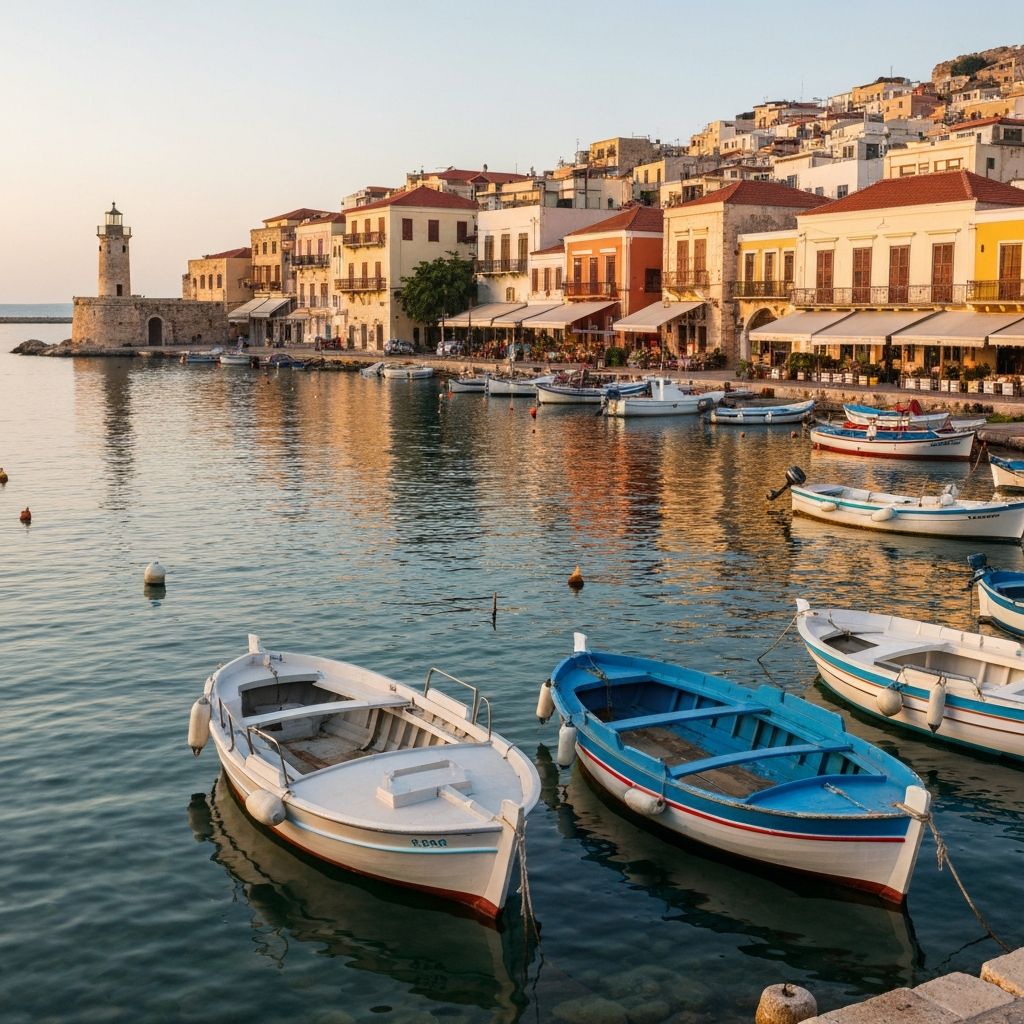
Crete is large enough that you could spend a month and still not see everything. This guide is selective — it focuses on places that reward time and attention, rather than those that simply appear on every itinerary.
Old towns
Chania old town
One of the most beautiful old towns in Greece. The Venetian harbour, the covered market, the narrow streets of the Jewish quarter, the mosque by the water: Chania repays a slow day on foot. Stay in the old town if you can — several excellent smaller hotels are inside the historic area.
Recommendation status: Locally confirmed, extensively visitor-reviewed
Rethymno old town
Smaller than Chania but similarly Venetian in character. The Fortezza (castle) is worth climbing for the views. The harbour area and the streets immediately behind it have good tavernas. Less crowded than Chania, and a good base for south coast day trips.
Recommendation status: Locally recommended
Heraklion
The capital is often dismissed as just an airport city. It is worth more than that — the Heraklion Archaeological Museum is outstanding, the covered market is one of the best in Crete, and the city has a genuine local life that resort areas lack. That said, it is a busy working city rather than a picturesque one.
Recommendation status: Locally recommended
Archaeological sites
Knossos
The major Minoan palace site, about 5 km from Heraklion. Extensively reconstructed — opinions are divided on this, but it does allow visitors to grasp the scale and layout of a Bronze Age palace. Visit early morning to avoid the worst of the crowds.
Recommendation status: Visitor-reviewed, locally confirmed
Phaistos
A second Minoan palace on the Messara plain, overlooking the landscape rather than surrounded by tourist infrastructure. Less visited than Knossos, less reconstructed, and arguably a better archaeological experience.
Recommendation status: Locally recommended
Aptera
A less-visited ancient city near Chania. Greek and Roman ruins in a quiet setting, with good views across the bay toward Souda. Worth half a day if you are in the Chania area and interested in archaeology.
Recommendation status: Locally recommended
Villages and mountain towns
Anogia
A mountain village on the slopes of Mount Ida (Psiloritis), known for its music and its difficult history during the Second World War occupation. The village has strong traditions in weaving and music. Worth the drive if you are going to or from the south coast via the mountain route.
Recommendation status: Locally recommended
Archanes
A well-preserved village south of Heraklion, known for wine production and proximity to the Minoan cemetery at Fourni. A quieter alternative to Knossos-area tourism.
Recommendation status: Locally recommended
Sfakia (Chora Sfakion)
The main town on the south coast of western Crete, gateway to Loutro and the end point for Samaria Gorge walkers. The town itself is functional rather than beautiful, but the setting is dramatic and the fresh fish is worth stopping for.
Recommendation status: Locally recommended
Gorges
Samaria Gorge
One of the longest gorges in Europe, running 16 km from the Omalos plateau to Agia Roumeli on the south coast. A full day’s walk, one way — you take a bus or ferry back. A genuine physical undertaking; not a casual stroll. The gorge closes during winter and after heavy rain.
Recommendation status: Visitor-reviewed, locally confirmed
Imbros Gorge
A shorter, easier alternative to Samaria — about 7 km one way. Less crowded, accessible from the Sfakia road. A good choice for those who want a gorge walk without the full day commitment.
Recommendation status: Locally recommended
Practical notes
- Many archaeological sites close on Mondays.
- Summer heat can make midday site visits uncomfortable — early morning is better.
- Some mountain villages are hard to reach without a car.
- The south coast has fewer tourist services but rewards the effort.