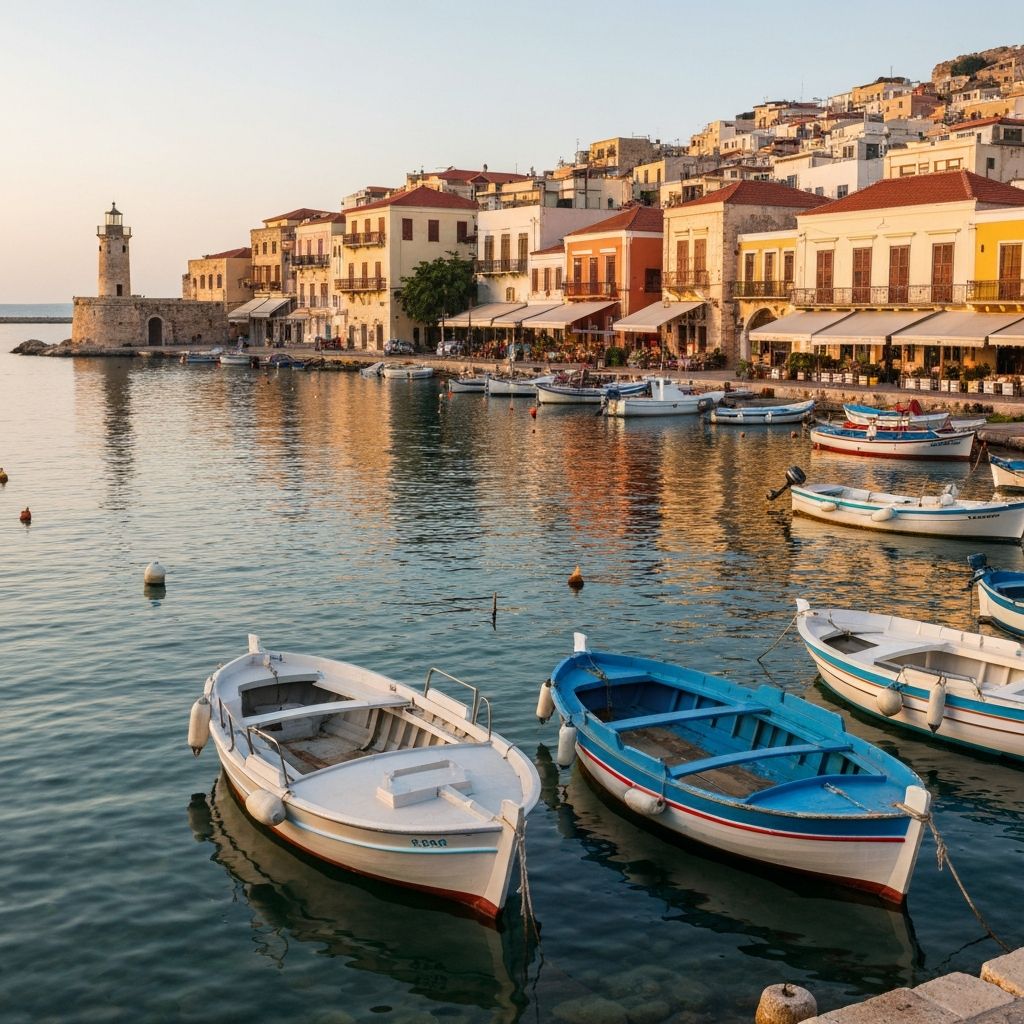
Chania is the second-largest city in Crete and, for many visitors, the most appealing. The old town — built on a Venetian harbour, with layers of Minoan, Byzantine, Venetian, Ottoman and modern Greek history — is one of the most photographed places in Greece, and deserves the attention.
The old town
The Venetian harbour is the centre of Chania’s identity. The lighthouse, the covered market, the mosque at the water’s edge, the narrow streets behind the harbour: this is a place that works on foot. Allow at least a full day. Stay in the old town if your budget allows — several characterful smaller hotels are inside the historic area.
The covered market (agora) is worth the visit for food shopping and for understanding how the city uses its historic infrastructure. The leather workshops and craft shops in the streets around Skridlof Street (locally called Leather Lane) are among the more genuinely local shopping options.
The Jewish quarter (Evraiki) behind the harbour, centred on the restored Etz Hayyim Synagogue, is one of the quieter and more atmospheric parts of the old town.
Wider Chania region
The Chania region extends across western Crete — from the dramatic Akrotiri peninsula north of the city, to the remote beaches of the far west (Elafonisi, Falasarna), to the mountains of the White Mountains (Lefka Ori) that form the spine of western Crete.
The Samaria Gorge starts on the southern edge of the White Mountains — an 8–16 km walk depending on direction — and is one of the most dramatic landscapes in Greece.
Getting there
Chania has its own international airport (CHQ), with flights from many European cities. The city centre is about 15 km from the airport.
Practical notes
- The old town is very busy in July and August — book accommodation well in advance.
- Many harbour-front restaurants are tourist-priced. A few streets inland, prices and quality improve.
- The covered market closes in the early afternoon.
- Chania is a good base for day trips west (Elafonisi, Balos) and south (Samaria, south coast).