In This Guide
- 1. Neolithic and Early Bronze Age (7000–2000 BCE)
- 2. The Minoans (2000–1100 BCE)
- 3. Greek and Roman Crete (1100 BCE–824 CE)
- 4. Byzantine Crete (395–824 CE and 961–1204 CE)
- 5. Venetian Crete (1204–1669)
- 6. Ottoman Crete (1669–1898)
- 7. The Cretan State and Union with Greece (1898–1913)
- 8. The 20th century
- 9. What to visit
Planning Your Visit
Crete has been continuously inhabited for at least 9,000 years. Its position at the crossroads of the eastern Mediterranean made it a prize — for traders, administrators, conquerors, and colonisers — across every major period of Western history. Layers of that past are still visible in the landscape, the towns, and the people.
Neolithic and Early Bronze Age (7000–2000 BCE)
The earliest evidence of human habitation on Crete dates to around 7000 BCE, when agricultural communities settled in the island’s fertile plains. These early inhabitants kept animals, made pottery, and buried their dead in collective tombs. By the Early Bronze Age (roughly 3000 BCE), population had grown significantly, trade networks with Egypt and the Levant were active, and metalworking skills had developed.
The Minoans (2000–1100 BCE)
The Minoan civilisation — named by archaeologist Arthur Evans after the mythical King Minos — is Crete’s most significant contribution to world history. At their height (roughly 1700–1450 BCE), the Minoans operated a sophisticated palace-based economy centred on redistribution of agricultural goods: olive oil, wine, grain, and wool.
The great palaces at Knossos (near Heraklion), Phaistos (on the Messara plain), Malia (on the north coast), and Zakros (in the far east) were administrative, religious, and commercial centres — not fortresses. They were undefended, suggesting a degree of political stability, or at least that threats came primarily from within rather than without.
Minoan Crete developed the earliest writing systems found in Europe: Cretan Hieroglyphic (largely undeciphered) and Linear A (also undeciphered). A later script, Linear B, was adapted by Mycenaean Greeks and has been deciphered — it reveals administrative records rather than literary or religious texts.
The cause of the Minoan collapse remains debated. A massive volcanic eruption on Thera (Santorini), probably around 1600 BCE, caused significant disruption. By around 1450 BCE, the palaces were destroyed or abandoned — possibly as a result of invasion by Mycenaean Greeks from the mainland. The site of Knossos continued to be occupied and administered in Mycenaean style for another century before it too was abandoned.
Greek and Roman Crete (1100 BCE–824 CE)
After the Minoan collapse, Crete fragmented into small city-states — dozens of them, frequently at war with one another. The major cities included Knossos, Gortyn, Lyttos, and Kydonia (modern Chania). The island had no unified political structure during this period, though it was recognised as Greek and participated in Greek religious and cultural life.
Gortyn, in the Messara plain, became the most powerful city from around 300 BCE. Its most important legacy is the Gortyn Law Code (c. 450 BCE), carved on stone and surviving almost intact — one of the oldest and most complete law codes from the ancient Greek world. It covers property, family law, and the status of various social classes.
Rome conquered Crete in 69–67 BCE after prolonged resistance. The island became the province of Creta et Cyrenaica (combined with part of modern Libya). Gortyn served as the provincial capital. Roman Crete was largely peaceful; the island produced olive oil, wine, and timber for export. Early Christianity reached Crete: according to tradition, Titus, a companion of St Paul, became the first bishop of Crete, and the island has its own epistle in the New Testament addressed to him.
Byzantine Crete (395–824 CE and 961–1204 CE)
When the Roman Empire split in 395 CE, Crete became part of the Eastern (Byzantine) half. The island remained under Byzantine rule until 824 CE, when it was captured by Arab forces from Andalusia who had been exiled from Spain. These Arabs, based at a fortified settlement they called Chandax (modern Heraklion), used Crete as a base for piracy across the eastern Mediterranean for over a century.
Byzantine general Nikephoros Phokas reconquered the island in 961 CE after a lengthy siege of Chandax. Byzantine rule then continued until 1204.
Venetian Crete (1204–1669)
The Fourth Crusade’s sack of Constantinople in 1204 shattered the Byzantine Empire. Crete was sold to the Republic of Venice, which would hold it for over 450 years — the longest foreign occupation in the island’s recorded history.
Venice administered Crete primarily as a commercial asset. Olive oil and wine were exported; the island’s ports — especially Heraklion (which Venice called Candia) — became important stops on Mediterranean trade routes. The Venetians built extensive fortifications still visible today: the Koules fortress guarding Heraklion harbour, the Firkas fortress in Chania, the Fortezza at Rethymno, and numerous coastal watchtowers.
Cretan intellectual and artistic life flourished under Venetian rule, particularly in the 16th and 17th centuries — the period known as the Cretan Renaissance. The icon painter El Greco (Domenikos Theotokopoulos) was born in Heraklion around 1541, trained in the Byzantine icon tradition, and later achieved fame in Spain. The Cretan School of icon painting produced distinctive, influential work. The epic poem Erotokritos by Vitsentzos Kornaros (c. 1600) remains one of the greatest works of modern Greek literature.
Cretan resistance to Venetian rule was persistent. The island rose in revolt multiple times, most notably the Revolt of St Titus (1363–1365), when Cretan aristocrats allied with Venetian settlers to establish briefly an independent republic.
Ottoman Crete (1669–1898)
The Ottoman Empire began its campaign to capture Crete in 1645. Chania fell in 1645, Rethymno in 1646, but Heraklion (Candia) held out until 1669 — the longest siege in recorded history at that point, lasting 21 years. The fall of Candia effectively ended Venetian power in the eastern Mediterranean.
Ottoman rule brought significant changes: mosques, minarets, and fountains appeared in the towns; many Cretans converted to Islam (though some maintained Christian practice privately — the crypto-Christians). However, Ottoman administration was less stable than Venetian, and the island experienced a series of revolts. The most significant were the Greek War of Independence uprising (1821–1830) — which Crete participated in but was excluded from the independent Greek state — and the Great Cretan Revolt (1866–1869).
The Explosion at the Arkadi Monastery in November 1866 became one of the defining moments in Greek national memory. Besieged by Ottoman forces, the defenders detonated the monastery’s gunpowder store rather than surrender, killing hundreds — both Cretans and Ottoman soldiers. The event attracted international attention and support for Cretan independence.
The Cretan State and Union with Greece (1898–1913)
Following years of revolt and international pressure, the Great Powers (Britain, France, Russia, Italy) intervened in 1897–1898 and expelled Ottoman forces. The Cretan State was established in 1898 as an autonomous region under nominal Ottoman sovereignty, protected by the Powers.
Eleftherios Venizelos, born in Chania in 1864, emerged as the dominant Cretan politician and led the island’s struggle for union (Enosis) with Greece. He later became one of the most significant Greek prime ministers of the 20th century.
Crete formally united with the Kingdom of Greece on 1 December 1913, following the First Balkan War. The official union ceremony took place in Chania.
The 20th century
World War I saw Greece, under Venizelos, join the Allies. Crete provided significant numbers of troops.
World War II brought the Battle of Crete in May 1941. Germany launched the first major airborne invasion in history — Operation Mercury — deploying paratroopers across the island. Cretan civilians fought alongside British, Australian, New Zealand, and Greek forces in what became one of the most intense engagements of the war. Germany captured the island but suffered casualties so severe that Hitler reportedly declared he would never authorise another large-scale airborne operation.
The subsequent German occupation (1941–1945) was brutal. Mass reprisals against civilian villages followed resistance activity — Kandanos, Viannos, and many other villages were destroyed. The resistance, aided by SOE operatives from Britain, remained active throughout.
Post-war recovery was slow. Crete remained relatively poor through the 1950s and 1960s. Tourism began growing in the 1970s and transformed the economy over the following decades.
What to visit
Heraklion Archaeological Museum: The definitive collection of Minoan art and artefacts. Essential context before visiting Knossos.
Palace of Knossos: The largest Minoan site, partially reconstructed. 5km east of Heraklion.
Gortyn: Roman and Byzantine archaeological site in the Messara plain, including the Law Code inscription and early Christian basilica.
Phaistos: Minoan palace, less visited than Knossos, with excellent views over the Messara.
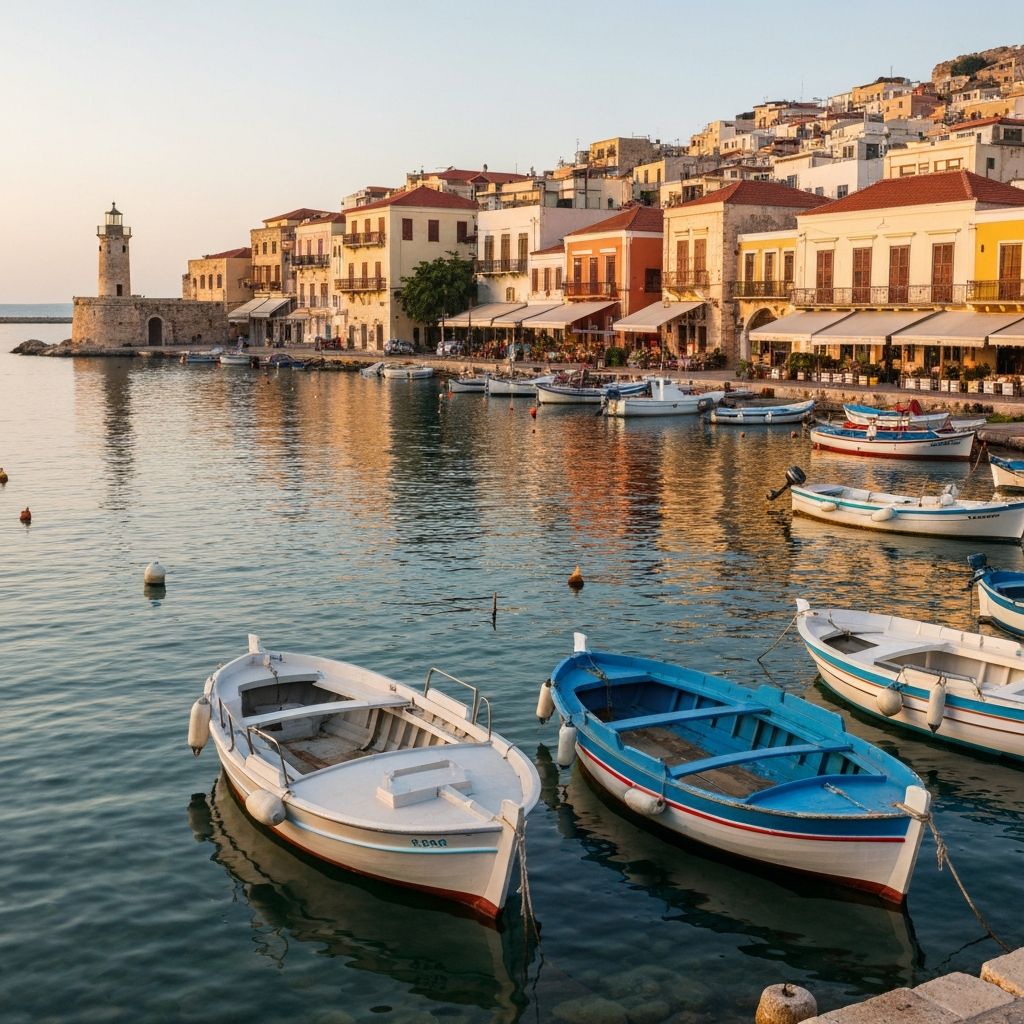
Chania old town: Venetian harbour, lighthouse, and old streets. The archaeological museum occupies a former Venetian church (later an Ottoman mosque).
Arkadi Monastery: Active monastery near Rethymno with a museum documenting the 1866 revolt.
Rethymno old town: One of the best-preserved Venetian/Ottoman townscapes in the Aegean.
Frequently Asked Questions
Who were the Minoans?
The Minoans were a Bronze Age civilisation that flourished on Crete from roughly 3000 to 1100 BCE. They built elaborate palace complexes at Knossos, Phaistos, and elsewhere, traded widely across the Mediterranean, and developed one of the earliest writing systems in Europe.
When did Crete become part of Greece?
Crete formally united with the Kingdom of Greece in 1913, following the Balkan Wars. The island had achieved autonomy from the Ottoman Empire in 1898 and was administered as the Cretan State under Ottoman nominal sovereignty and great-power protection until union.
How long did the Venetians rule Crete?
The Venetians controlled Crete from 1204 until 1669 — a period of over 450 years. Venetian influence is visible today in the architecture of Heraklion, Chania, and Rethymno, particularly the old harbours and fortifications.
What was the Battle of Crete?
The Battle of Crete (May 1941) was a German airborne invasion during World War II. It was one of the first major battles in which paratroopers were used as the primary assault force. Cretan civilians fought alongside Allied forces. The Germans captured the island but suffered heavy losses that led Hitler to abandon large-scale airborne operations.
What is the significance of Knossos?
Knossos was the largest Minoan palace complex and the administrative centre of Minoan Crete. Excavated by Arthur Evans from 1900 onwards, it is the most-visited archaeological site in Crete. The myths of King Minos, the Minotaur, and the Labyrinth are set here.
- 1. Heraklion Archaeological Museum
The primary collection of Minoan artefacts, with permanent displays covering Cretan prehistory through the Roman period
- 2. Palace of Knossos official site
Archaeological site managed by the Greek Ministry of Culture
- 3. John Pendlebury, 'The Archaeology of Crete' (1939)
Classic scholarly survey of Cretan archaeology